
In the digital world, traffic alone is not enough. You can drive thousands of visitors to a website every day—but if they don’t take profitable actions, your growth eventually hits an invisible ceiling. That’s where optimizing your conversion rates becomes essential.
Conversion Rate Optimization is the strategic process of increasing the percentage of visitors who complete a desired action—whether it’s making a purchase, signing up, filling out a form, downloading an asset, or even simply clicking a button. While it sounds straightforward, CRO is one of the most data-driven and psychology-driven disciplines in digital marketing.
In this comprehensive guide, we’ll break down everything you need to know about CRO—what it is, why it matters, how it works, and the top strategies brands use to maximize conversions.
What Is Conversion Rate Optimization?
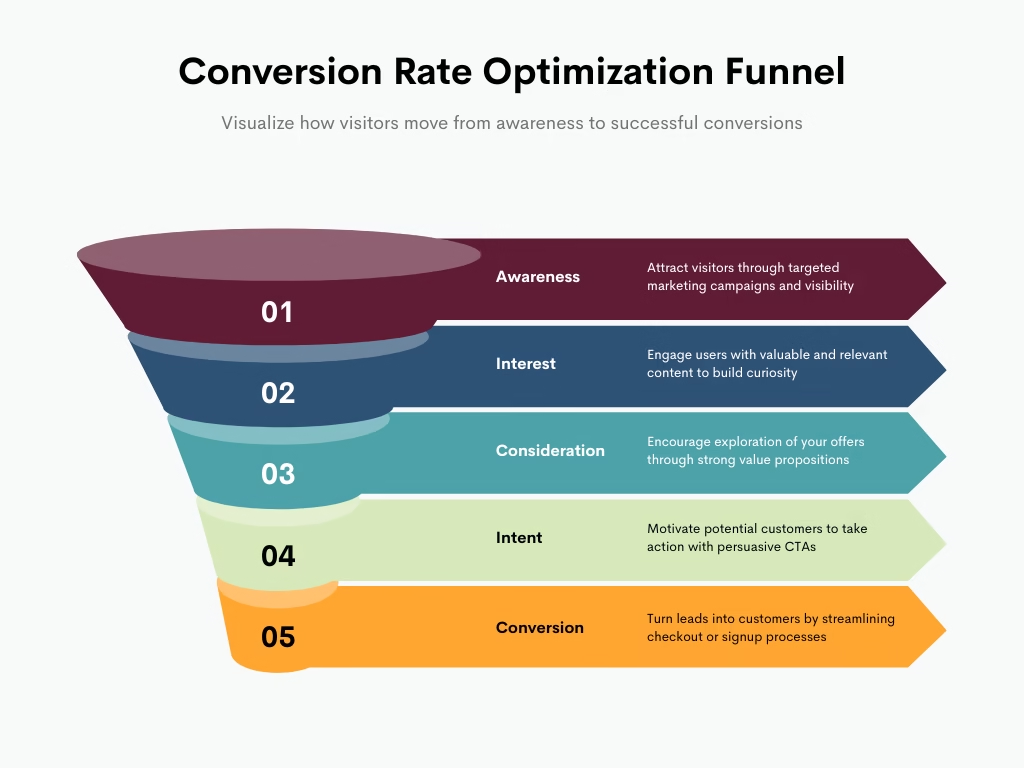
At its core, Conversion Rate Optimization is the practice of improving your website or landing page experience to persuade more visitors to convert.
A “conversion” depends on your business goals:
For e-commerce: a purchase
For SaaS: a trial signup
For lead generation: form submissions
For bloggers: email subscriptions
For service businesses: booking consultations
For mobile apps: downloads or in-app actions
The conversion rate can be calculated as:
To find the conversion rate, take total conversions, divide by total visitors, and multiply by 100.
So if 2,000 visitors land on a page and 100 make a purchase, your conversion rate is 5%.
CRO aims to increase that number without necessarily increasing traffic, making it one of the most cost-effective marketing strategies available.
Why Conversion Rate Optimization Matters More Than Ever
The digital space is more competitive, more crowded, and more expensive than ever. Paid ads cost more, SEO takes time, and social media reach keeps declining. This is why CRO is powerful—it focuses on maximizing what you already have.
- Higher ROI from existing traffic
Increasing your conversion rate from 2% to 4% effectively doubles your revenue without spending extra on ads.
- Reduced Customer Acquisition Costs (CAC)
If more people convert, your CAC naturally drops. This increases your overall marketing efficiency.
- Better user experience
CRO forces you to study user behavior, remove friction, simplify navigation, and create intuitive design—all resulting in happier visitors.
- Competitive advantage
Even small improvements can give you a big edge. If your landing page converts 50% better than competitors’, you can outbid them in ads, out-rank them in SEO, and out-perform them across the board.
- Scalability
A well-optimized funnel scales easily with increased traffic.
In short, Conversion Rate Optimization is the art of making your website work harder and smarter.
Key Elements of an Effective CRO Strategy
To optimize conversions, you must understand how users think, what motivates them, and what stands in their way. CRO blends psychology, design, analytics, and marketing.
Below are the pillars of a high-impact Conversion Rate Optimization framework.
1. User Behavior Analysis
Understanding visitor actions is the foundation of CRO. This involves:
Heatmaps
Shows where users click, scroll, hesitate, or ignore.
Session Recordings
Reveals frustration points, broken elements, and hesitation patterns.
User Surveys & Feedback
Gives qualitative insights directly from real people.
Questions like:
- “What stopped you from completing your purchase?”
- “What information was missing?”
Analytics Tools
Google Analytics, Mixpanel, and similar tools uncover:
- Bounce rates
- Exit pages
- Drop-off points
- Device-based issues
Understanding behavior helps identify why people aren’t converting.
2. Value Proposition Optimization

Your value proposition is the reason customers choose you over others.
Strong value propositions answer:
- What do you offer?
- Who is it for?
- Why is it better?
Weak messaging = fewer conversions.
Examples of strong value propositions:
- Slack: “Be more productive at work with less effort.”
- Shopify: “The best way to start your online business.”
Test your value proposition using A/B tests, different headline variations, or changing the hero text.
3. Landing Page Optimization
Your landing page is a make-or-break moment. Key elements include:
High-impact headline
Clear, benefit-driven, and concise.
Strong visuals
Images and videos increase understanding and trust.
Social proof
Testimonials, reviews, logos, stats.
Clear Calls to Action (CTA)
Your CTA must be:
- Visible
- Action-oriented
- Benefit-focused
Examples: - “Get Started Free”
- “Book a Free Call”
- “Claim Your Discount”
Fast loading speeds
A 1-second delay can drop conversions by up to 7%.
Responsive design
Mobile optimization is non-negotiable.
4. A/B Testing
A/B testing compares two versions of a page to see which performs better.
Test elements like:
- Headlines
- CTA colors
- Button placement
- Form length
- Product descriptions
- Pricing structure
Important: Only test one variable at a time for accurate results.
5. Improving Site Speed & Technical Performance
Conversion rates drop sharply when loading times increase.
Key optimizations include:
- Image compression
- Caching
- CDN usage
- Minifying CSS/JS
- Lazy loading
The faster your site, the higher your conversions.
6. Trust & Credibility Factors
Your visitors won’t convert if they don’t trust you.
Build trust with:
- Verified reviews
- SSL certificates
- Return policies
- Secure payment badges
- About page with real team photos
- Case studies or success stories
People buy from brands they feel safe with.
Most Effective Conversion Rate Optimization Tactics (Proven Strategies)
Now let’s explore practical, powerful, and immediately actionable CRO strategies that businesses across industries use successfully.
1. Simplify Your Forms
Shorter forms = higher completion rates.
Remove unnecessary fields and only request what you truly need.
Pro Tip: Multi-step forms often convert better because they feel shorter.
2. Add Exit-Intent Popups
Exit-intent popups can:
- Reduce bounce rate
- Capture emails
- Offer discounts
- Promote lead magnets
They trigger when a user tries to leave, giving you one last chance to persuade.
3. Use Scarcity and Urgency
Psychological triggers like scarcity drive faster decisions.
Examples:
- “Only 3 left in stock.”
- “Sale ends in 1 hour.”
- “Limited spots available.”
Used ethically, these significantly increase conversions.
4. Use High-Quality, Authentic Visuals
Visuals should communicate trust and clarity:
- Real product photos
- Explainer videos
- Before/after images
- User-generated content
People trust what they can see.
5. Personalized User Experience
Personalization boosts engagement dramatically.
Examples:
- Showing recommended products
- Location-based offers
- Returning-visitor messaging
- Smart product filters
Amazon is the king of personalization—and its conversion rate proves it.
6. Optimize Your Checkout Process
For e-commerce, abandoned carts are a major problem.
Fix them by:
- Reducing checkout steps
- Enabling guest checkout
- Showing shipping costs upfront
- Providing multiple payment options
- Offering one-click checkout
Small changes produce significant lifts in sales.
7. Strengthen Your CTA Design & Placement
A strong CTA can change everything.
Best practices:
- Use contrasting colors
- Place CTAs above the fold
- Repeat CTAs across long pages
- Use action verbs
Avoid vague CTAs like “Submit.”
Be specific, like “Download Your Free Guide.”
8. Leverage Social Proof
Social proof reduces hesitation.
Types include:
- Reviews
- Star ratings
- Media mentions
- Number of customers
- Influencer endorsements
- Case studies
Every piece of social proof adds credibility to your offer.
The Psychology Behind CRO: Why Users Convert

Understanding psychology is a hidden superpower in Conversion rate optimization. People are emotional decision-makers.
Here are key principles:
1. FOMO (Fear of Missing Out)
Used in scarcity/urgency strategies.
2. Cognitive Ease
Simple pages convert better because the brain dislikes effort.
3. Authority Bias
People trust experts, brands, and influencers.
4. Social Proof
People follow what others are doing.
5. Anchoring
Showing a high price first makes a lower price feel like a great deal.
6. Reciprocity
Giving value upfront (like free guides or trials) makes people feel inclined to return the favor.
Harnessing these principles boosts persuasion and conversions.
CRO for Different Business Types
Let’s break down how conversion optimization differs by model.
1. CRO for E-Commerce
Key goals:
- Add-to-cart rate
- Checkout completion
- Average order value
Top tactics:
- Product page optimization
- Trust badges
- User-generated content
- Abandoned cart recovery emails
2. CRO for SaaS
Goals:
- Trial signups
- Demo requests
- Onboarding completion
Strategies:
- Reduce friction in signup
- Clear pricing
- Feature comparison tables
- In-app guided onboarding
3. CRO for Lead Generation
Goals:
- Form fills
- Phone calls
- Email signups
Strategies:
- Multi-step forms
- Lead magnets
- Exit-intent popups
- Strong landing page copy
CRO Tools That Make Optimization Easier

Here are top tools CRO professionals use:
Analytics
- Google Analytics
- Mixpanel
- Adobe Analytics
Heatmaps & Recordings
- Hotjar
- Mouseflow
- Crazy Egg
A/B Testing
- Google Optimize (sunset, but alternatives exist)
- Optimizely
- VWO
User Feedback
- Typeform
- SurveyMonkey
- Qualaroo
Landing Page Builders
- Unbounce
- Leadpages
- Instapage
These tools help you analyze, test, and improve performance continuously.
Creating a CRO Roadmap: The Step-by-Step Process

Here is a clear CRO process you can implement today:
Step 1: Analyze
Review:
- Heatmaps
- Drop-off points
- Device breakdowns
- Slow-loading pages
Step 2: Identify Issues
Common issues include:
- Confusing navigation
- Weak value proposition
- Lack of trust elements
- Poor mobile usability
- Long forms
Step 3: Hypothesize
Example hypothesis:
“If we simplify the signup form from 8 fields to 3 fields, conversions will increase.”
Step 4: Implement Changes
Make the improvements based on data.
Step 5: A/B Test
Run tests to validate whether your hypothesis was correct.
Step 6: Measure Results
Compare before vs. after metrics:
- Conversion rate
- Bounce rate
- Page engagement
- Revenue impact
Step 7: Repeat
Conversion rate optimizationRO is continuous. There is always room for improvement.
Common CRO Mistakes to Avoid

Even seasoned marketers make these errors. Avoid them to save time and increase results:
1. Making decisions without data
Gut feelings are not CRO strategies.
2. Testing too many things at once
It creates unclear results.
3. Ignoring mobile users
Most traffic is mobile. Don’t optimize desktop only.
4. Copying competitors blindly
What works for them may not work for you.
5. Changing elements too quickly
A/B tests need enough traffic to reach statistical significance.
6. Forgetting user psychology
Design alone won’t convert—persuasion does.
The Future of Conversion Rate Optimization
CRO is evolving rapidly, especially with AI and personalization.
Future trends include:
- AI-powered dynamic content
- Predictive personalization
- Micro-segment targeting
- Voice-driven conversion funnels
- Multivariate testing automation
- Behavioral biometrics
Businesses that embrace these will see exponential gains in conversion performance.Final Thoughts: Why CRO Should Be a Priority in 2025 and Beyond
Conversion Rate Optimization is no longer optional—it’s a competitive necessity. With increasing ad costs, crowded markets, and rising customer expectations, brands that fail to optimize will fall behind.
But the good news?
CRO is one of the highest-ROI marketing investments you can make.
You don’t need more traffic—you need more action from the traffic you already have.
Whether you run a small business, a SaaS platform, a global e-commerce store, or a personal brand, mastering CRO will transform your digital performance.